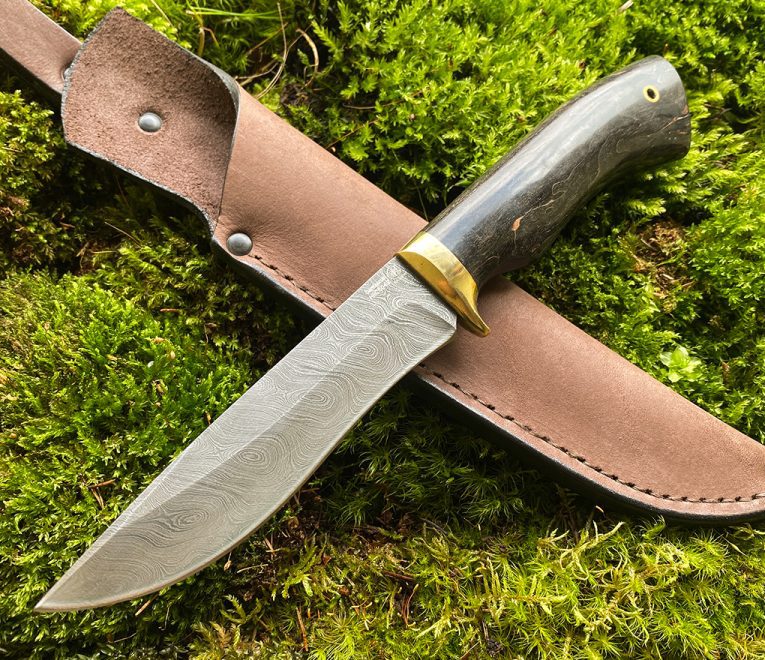
Knife specifications: “TREJASMENS”
Steel: U10 forged carbon steel
Hardness: 58–59 HRC
Blade length (mm): 267 / 10.51 inches
Blade thickness (mm): 5 / 0.19 inches
Blade width (mm): 48 / 1.88 inches
Handle: African wenge wood
Total length (mm): 400 / 15.74 inches
Knife type: hunting, outdoor
Included in the package: knife, leather sheath
The word “TREJASMENS” refers to a weapon with three striking surfaces
The distinctive shape of this weapon is attributed specifically to the Latgalians. At the same time, the “skramasax” was also widely used in Estonia and Finland,
The shape of the blade itself can be described as medically anatomical, as it was designed based on a deep understanding of the blade’s movement and its ability to make deeper incisions and bone cuts.
The length of the sword deserves special attention—the three-edged sword is a deeply personalized weapon because, in order to achieve the greatest possible effectiveness in battle, it must match the length of the fighter’s forearm, thus “becoming an extension of the hand.” In short, this is an anatomically superb weapon from both perspectives.
This type and form of close-combat sword has long belonged to the ancient Latvians—the Latgalians—as evidenced by archaeological finds from the Middle (8th century) and Late Iron Ages (13th century) in the territory of historical Latvia.
Fighting with the ‘TREJASMENS’ is an art. A martial art rooted in long-term observations of nature, a deep understanding of the laws of nature, and precision and intuition in movement. An art passed down from generation to generation.
‘TREJASMENS’ possesses all the hallmarks of a traditional weapon—it features a mounting method tested in practice and refined over the centuries, a specially designed blade, and is celebrated in folklore.