


Diamond Sharpening Stones Reveal Why Sharpening Is a Craft, Not a Trick
The secret of a sharp knife rarely lies in the blade itself. More often, it lies in the tool used to maintain it—and diamond sharpening stones are among the most precise instruments ever created to restore sharpness to steel. To understand why a quality stone costs what it does, and why grit sequence is not arbitrary, it’s worth looking at how such a tool is actually made.
Raw Material: Why Diamond?
Diamond is the hardest material known to nature, and that means one simple thing—it sharpens virtually any steel, even those containing large amounts of tungsten or vanadium carbide, and resists wear better than ordinary whetstones. Industrial production uses synthetic diamond because it is more uniform than natural diamond and allows grain size to be controlled with great precision. Each grain is a microscopic cutting tool—the smaller it is, the finer the surface it leaves on the metal.
This is precisely why diamond stones don’t wear the way water stones or ceramics do: diamond doesn’t change shape; it simply cuts as long as it stays bonded to the base.
Base and Coating: The Process That Determines Durability
A metal plate—usually steel or aluminum—is prepared with precise perforations or roughening so the diamond coating bonds to it securely. The surface is then coated with a nickel binder in which diamond grains are embedded. This process is called electroplating, and it requires stable current control—if the process happens too quickly, grains arrange unevenly, and the sharpening surface becomes patchy.
As a result, each stone must have uniform grain density across its entire length; otherwise, steel will be removed faster on one edge than the other during sharpening—and the blade edge will become uneven.
Grain Calibration: Why the Number on the Package Is Not Just a Label
Grit or grit number indicates how fine the diamond particles are—the higher the number, the finer the grain. In production, grains are sifted through a series of screens so that only particles of a specific size reach each batch. It’s a process where even small deviations can change how a stone performs: too coarse a mixture in a 1000 grit stone will leave scratches where smoothness should be.
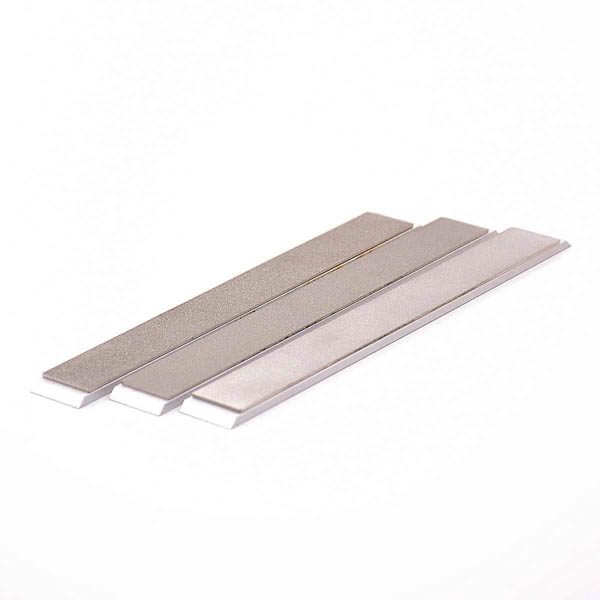
A set with three different stones—for example, 240, 600, and 1000 grit—is not a random choice but a logical progression: the coarse stone removes defects and creates a new edge, the medium stone smooths the surface, the fine stone imparts final polish and sharpness.
Assembly on a System: Why Format Matters
A hand-held stone is one thing, but many sharpeners today choose systems with a fixed angle—Hapstone, TSProf, Edge Pro, and similar designs. Here, stone size and mounting form are as important as the diamond coating itself. For example, Diamond sharpening stone set ZHUK DIAMOND 240, 600, 1000 grit, 20mm is designed specifically for the Edge Pro format with a 20mm width, meaning it fits both original systems and compatible ones without extra mounting tricks.
Such compatibility is not a minor detail—an incorrect size can mean unstable contact with the blade and an inconsistent angle throughout sharpening.
Handwork That Remains After the Factory
Although most of the process is industrial, the final stage often remains in human hands—visual inspection of each stone, edge treatment so they are not sharp and won’t cut hands, and labeling. A craftsman working with such tools every day immediately notices if the coating is thin or uneven—it’s felt in the very first stroke across metal.
How to Correctly Use the Grit Sequence in Practice
- Start with the coarsest stone (for example, 240 grit) only if the blade has damage or an altered angle.
- Move from one stone to a finer one only when the previous one has created a uniform burr across the entire blade edge.
- With a 1000 grit stone, work with a light hand—the goal is polish, not material removal.
- Clean the stone regularly with water and a soft brush to prevent metal dust from blocking the diamond grains.
Care to Keep Diamond Coating Functional
A diamond stone doesn’t suffer from rust the way carbon steel blades do, but the nickel binder can wear over time if the stone is used incorrectly—for example, with excessive pressure or without fluid to reduce friction. After each use, rinse the stone and let it dry naturally; store it in a dry place. Check your country’s laws regarding sharp tool transportation if you plan to carry a sharpening set while traveling or hunting—regulations vary by country.
Why This Process Is Worth Understanding
A diamond stone looks like a simple piece of metal with a shiny surface, but behind it lies a precisely calibrated process—from diamond particle size to coating uniformity. The next time you sharpen a knife, remember that the stone itself is made just as carefully as the blade you’re maintaining with it.
Frequently Asked Questions
Why are diamond stones better than ordinary whetstones?
Diamond is harder than most types of steel, so it sharpens even complex, high-hardness blades efficiently, where traditional stones work slower or wear out faster.
What sequence should I follow when using 240, 600, and 1000 grit stones?
Start with the coarsest (240 grit) to create or restore an edge bevel, move to 600 grit for refinement, and finish with 1000 grit for final polishing.
Do these stones work with any sharpening stand?
This set is designed for the Edge Pro format and is also compatible with Hapstone, TSProf, and ZHUK systems that use the same mounting standard.
How should I care for a diamond stone to make it last?
After use, rinse it with water, wipe metal dust with a soft brush, and let it dry naturally before storing in a dry place.
Can diamond stones rust?
The diamond coating itself doesn't rust, but the metal base can corrode if stored in damp conditions for long periods, so drying after use is important.
Diamond sharpening stone set ZHUK DIAMOND 240, 600, 1000 grit, 20mm
 No products in the cart.