


How to Revive an Abandoned Knife Step by Step
Your great-grandfather’s knife sits in a corner, in the garage, or in an inheritance from grandma’s kitchen. It has rust spots, a dull edge, a loose handle, and maybe even a broken tip. In most cases, such a knife can be revived on your own—you just need to know the right order to work in and where to stop to avoid damaging what’s still functional.
1. Assess the damage before you start
Before cleaning or sharpening, examine the knife in good light. Three questions will help you understand how far you can go on your own:
- Is the rust superficial (orange-brown spots) or has it already eaten into pits in the metal?
- Is the edge just dull, or does it have chips, a bend, or a broken tip?
- Does the handle move in all directions, or just wobble slightly?
Superficial rust, a dull edge, and a slightly loose handle you can fix at home. Deep corrosion, a broken tip, or a crack in the handle material—that’s a case for a professional.
2. Rust removal
Light rust requires only gentle cleaning—no metal brushes or coarse sandpaper, as they will scratch the blade irreversibly.
- Soak a cloth in white vinegar or lemon juice solution, apply it to the rust for 10-15 minutes.
- Rub with a cork piece dipped in baking soda, or use fine (1000-2000 grit) wet sandpaper.
- Rinse and dry immediately—moisture is rust’s best friend.
- After cleaning, apply a thin coat of oil (regular cooking oil works for now; mineral oil is better long-term).
If rust has left pits, the surface will remain slightly rough even after cleaning—this is normal and doesn’t affect cutting quality if the metal itself is sound.
3. Handle tightening
A loose handle is most common with wooden or bone handles that have dried out or lost grip over time.
- If the handle is secured with rivets, check whether they’re loose—sometimes a gentle tap with a hammer through a soft spacer helps.
- If the handle material has dried and created a gap, you can use wood-swelling compounds or epoxy putty to fill the void.
- You can disassemble and re-glue the handle with epoxy yourself if you’re willing to work slowly and carefully—but if there’s corrosion under the handle on the tang, it’s better to let a professional handle it, as an improperly reassembled handle can become dangerous in use.
4. Blade restoration—when sharpening is enough
A dull but intact edge is the simplest repair. If the blade is just worn, start with medium grit and finish with fine to get a clean, shiny edge.
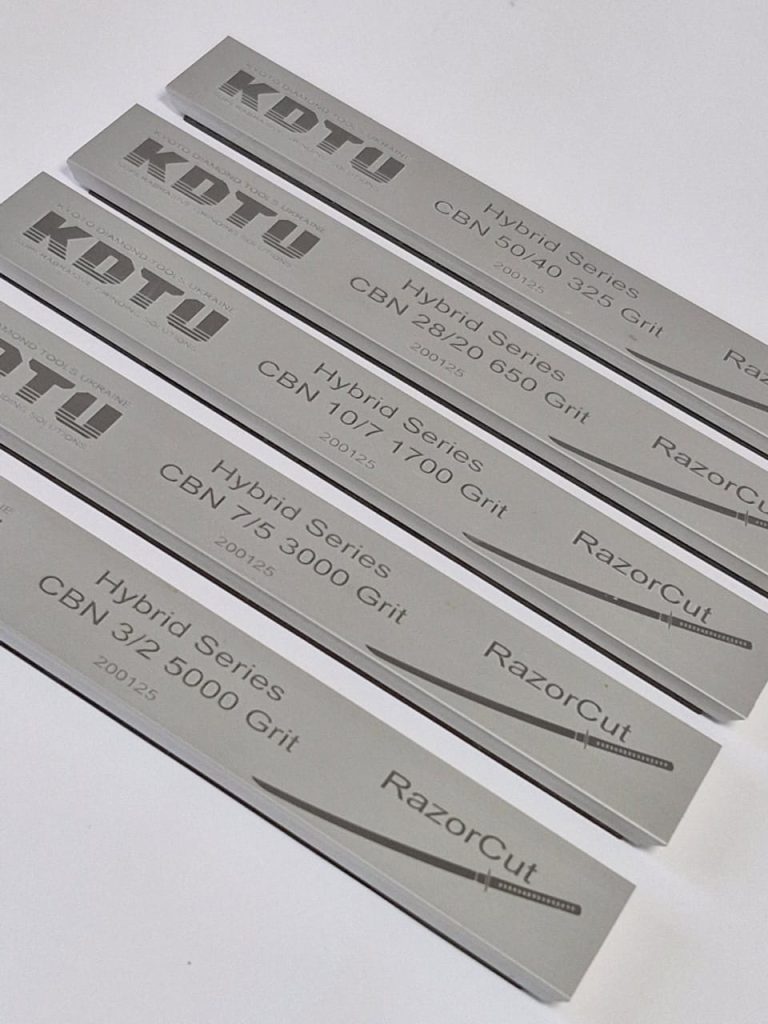
This is where stones with a wide grit range come in handy—for example, KDTU Hybrid CBN Diamond Grinding Wheels for Sharpening Knives offers a selection from 60 grit for rough shape restoration to 15000 grit for mirror polish, allowing you to complete the entire journey from a damaged edge to razor sharpness in one kit.
A practical work plan for home conditions:
- Start with 300-600 grit to restore the basic edge angle.
- Move to 1000-1500 grit to remove scratches left by the coarse stone.
- Finish with 3000 grit or finer to achieve a smooth, sharp edge.
- When working with harder steels or powdered metals, hybrid CBN diamond stones maintain aggressiveness longer than regular ceramic or water stones.
If you’re unsure about the angle, start with light pressure and more strokes—slow and even is better than fast and uneven.
5. Broken tip or bend—when to call a professional
Small chips in the blade edge (a few millimeters) can still be smoothed by grinding the entire edge down to a lower line—it takes patience and a coarse stone, but it’s doable at home.
However, if:
- the tip is missing more than 5-10 mm,
- the blade is bent or twisted,
- there are visible cracks in the metal,
- the handle is loose on the tang itself, not just the handle material,
then it’s better to trust a knife maker or sharpening service where proper equipment can restore the shape without the risk of overheating. If you overheat the blade yourself with a grinder, you can lose its hardness—and you can’t test that at home.
6. How not to damage the knife again
After restoration, it’s important to change the habits that led to the original condition:
- Dry the knife immediately after washing, never leave it wet on a table or in a sink.
- Store it in a wooden block, on a magnetic strip, or in a sheath—never with other metal items in a drawer.
- Regularly, but infrequently, coat the blade with a thin layer of oil, especially if the work involves carbon steel.
- Sharpen in small amounts frequently, not once a year with great effort—edge restoration will become easier and faster.
For specific rules about blade transport and storage if you plan to take your knife on trips or hunting, check your local regulations—they vary in every country.
Summary
Rust, dullness, and a loose handle are not reasons to throw away a knife—most can be fixed on your own with patience and the right sequence. But once you’re dealing with metal deformation or a missing tip, trust a professional. A knife that receives attention in time will serve much longer than one that’s neglected until the next emergency.
Frequently Asked Questions
Can light rust be removed without chemical cleaners?
Yes, often vinegar or lemon juice solution and gentle rubbing with cork or fine wet sandpaper is enough, without aggressive chemicals.
How do you know when blade damage is too serious for home repair?
If a large part of the tip is missing, the blade is bent, or there are visible cracks in the metal, it's better to see a knife maker rather than try to fix it yourself.
Why use multiple sharpening stones of different grits instead of just one?
A coarser stone quickly restores shape and angle but leaves scratches. Finer stones remove these scratches and give the edge a smooth, sharp finish.
Is oil necessary when sharpening?
No, many hybrid stones can be used dry, but oil helps improve finish quality, especially in the final, finer stages.
How should you store a knife to prevent rust?
Always dry the knife after washing, store it in a wooden block or on a magnetic strip, and occasionally coat the blade with a thin layer of oil.
KDTU Hybrid CBN Diamond Grinding Wheels for Sharpening Knives
 No products in the cart.