


Evaluate a Knife Before Purchase, Not After Years of Use
Two knives lie in the kitchen drawer. One was bought on sale five years ago—its edge has long since become wavy from frequent sharpening, and the handle wobbles when you pick it up. The other is hand-forged, used just as long, and still slices tomatoes cleanly without pressing. The difference is not by chance—it is the sum of steel quality, design, and craftsmanship.
To understand when a cheaper solution is adequate and when investing more makes sense, it helps to look at what happens to a knife over years. Wear does not affect all parts equally—some details can be restored, others fail irreversibly.
What fails first in mass-produced knives
In cheaper knives, problems typically arise in three places:
- Edge – soft or unevenly hardened steel loses sharpness quickly, and each sharpening removes more metal than it should.
- Handle-to-blade connection – glued or loosely fastened joints begin to shift over time, and the handle starts to bind or rattle.
- Handle material – unstabilized wood absorbs moisture, cracks, and warps.
These problems often appear in the first two or three years of use, not after a decade—which is why a cheap knife that seems adequate initially actually has a short practical lifespan.
What can be repaired, what cannot
Not all wear is permanent. It is worth knowing what can be fixed:
- Dull edge – always repairable if the steel is quality and the work done correctly, with gradual grit progression.
- Loose handle – sometimes can be tightened or reglued, but if the construction was weak from the start, the problem will return.
- Rust spots on carbon steel – removable if they have not worn deep pits into the blade.
- Cracked or dried wooden handle – practically unrepairable if the wood was not stabilized; the entire handle must be replaced.
- Broken or snapped blade tip – can be resharpened to a new shape, but blade length and proportions will change permanently.
Practical takeaway: steel quality determines how long a knife remains honing-able without significant material loss, while handle material determines whether a knife even survives to its second decade.
Why steel and craftsmanship change the equation
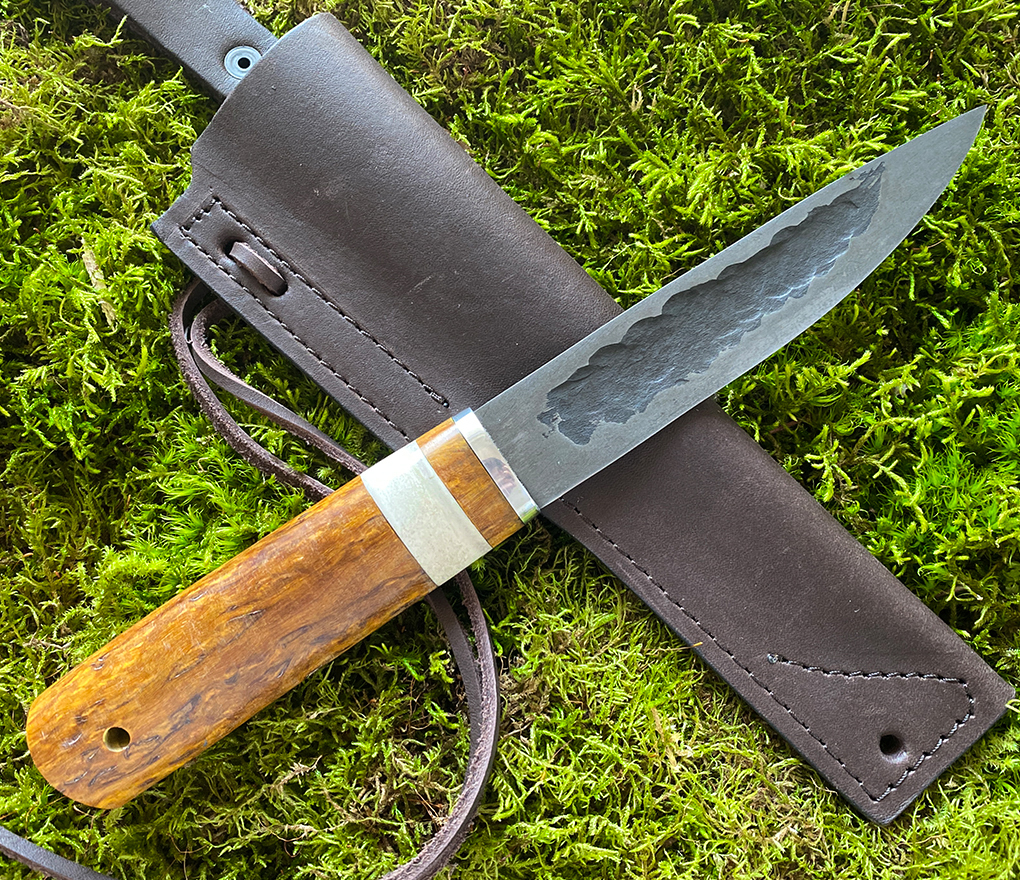
High-hardness steel holds an edge longer between sharpenings—meaning fewer sharpening cycles and slower edge material loss over years. For example, hand-forged bulat steel, such as used in the knife Knife “YAKUT” – forged Bulat-Wootz steel blade, for the right hand, combines high hardness with elasticity—a rarely achieved combination since typically harder steel becomes more brittle. By forging steel layers, a master achieves a structure more resistant to chipping and breaking than simple cast steel.
Stabilized wood for handles works by the same principle—the wood cells are infused with resins during treatment, so it no longer absorbs moisture, warps, or cracks the way untreated wood does.
This does not mean everyone should buy the most expensive knife available. If a knife is used rarely—for occasional camping trips or yard work a few times a year—a cheaper version can serve for years without issues. But if the knife is used daily—in the kitchen, hunting, fishing, where the edge constantly meets bone, scales, or hard materials—low-quality steel quickly shows its limits.
When investing more truly pays off
It is worth spending more if:
- The knife will be used multiple times per week, not once per season.
- Work involves hard materials—bones, dry branches, frequent contact with stones or metal.
- Edge retention between sharpenings matters, such as in hunting or fishing conditions where there is no time to stop and sharpen every hour.
- The knife is meant for long-term use or inheritance—a hand-forged knife with quality steel can serve several generations with proper care.
Conversely, if a knife is needed rarely, briefly, or for a specific one-time task, a cheaper solution is often the more sensible choice.
How to extend any knife’s lifespan
Regardless of price tier, certain habits help any knife last longer:
- Always dry the edge after washing, especially on carbon steel, which is prone to corrosion.
- Store the knife in a sheath or block, not loose in a drawer where it rubs against other items.
- Sharpen regularly, do not wait until the edge becomes nearly unusable—frequent, gentle sharpening preserves more material than rare, intense sharpening.
- Check the handle attachment occasionally—catching looseness early prevents larger damage.
- When transporting or storing a knife away from home, remember that regulations on blade length and carrying differ—always check local rules.
A knife is not a one-time purchase, but a tool whose lifespan depends largely on how you treat it. The right choice initially, combined with careful maintenance afterward, yields results you can feel in your hand—a smooth, safe cut after years, not disappointment after a few months.
Frequently Asked Questions
Does a cheap knife always mean poor quality?
Not always, but cheaper knives often use softer steel and unstabilized wood for handles, which wear faster under frequent use.
What wears out fastest on a knife?
Most commonly, the first problems are the edge losing sharpness and the handle-to-blade connection starting to move or bind.
Can a worn handle be replaced?
Yes, handles can often be replaced, but if the wood was not stabilized and has cracked, it is simpler and more economical to fit a new handle than to repair the old one.
How do I know if investing in a more expensive knife makes sense for me?
If you use the knife regularly, expose it to heavy loads, or want it to last for years without frequent sharpening, quality steel and craftsmanship pay off.
How do I care for a carbon steel edge to prevent rust?
After each use, dry the edge and store it in a dry place, avoiding prolonged contact with moisture or acidic foods.
Knife “YAKUT” – forged Bulat-Wootz steel blade, for the right hand
 No products in the cart.