


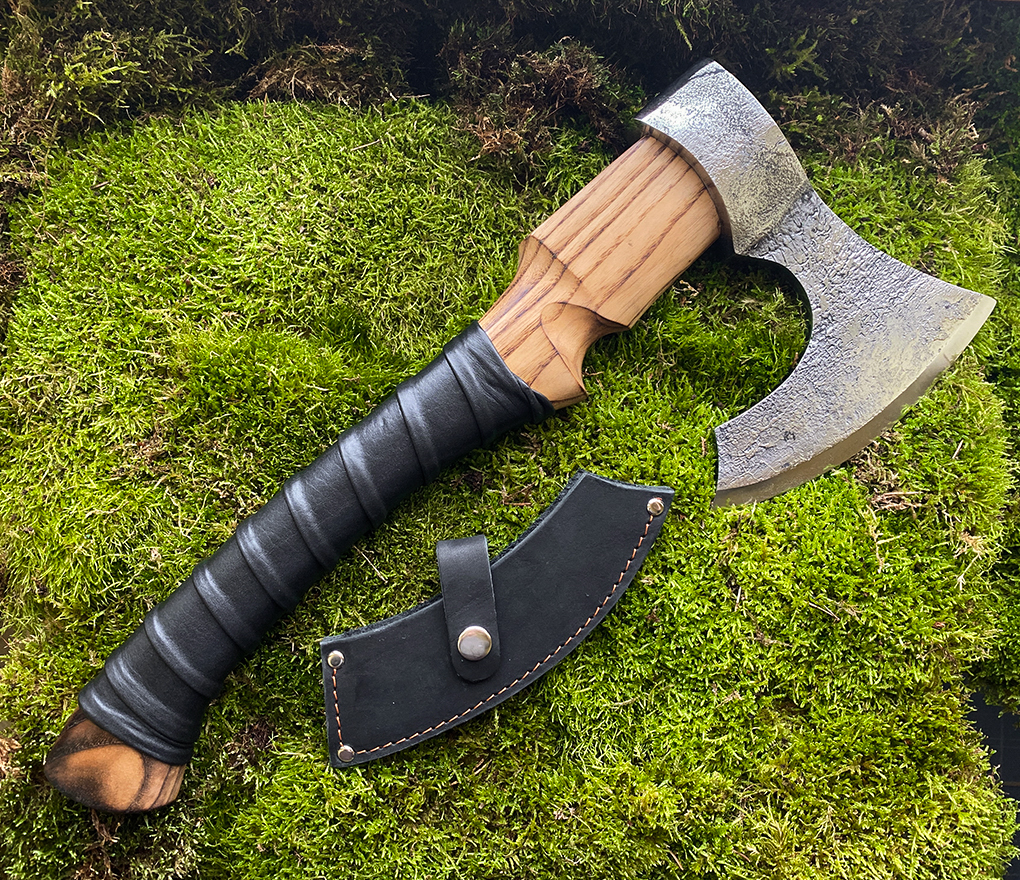
7 Craftsmanship Steps That Make an Axe a Real Tool
An axe looks like a simple object—a piece of metal on a wooden handle. Yet the path from a steel blank to a finished tool consists of several precisely executed steps, and their sequence and care determine how long and how well the axe will serve. Let’s examine what actually happens before the axe reaches the user’s hands.
1. Steel Selection and Preparation
It all starts with materials. Carbon steel is the choice craftsmen have used for centuries because it responds well to forging and can hold a sharp edge after hardening. For example, steel grade 9HS is known for good hardness and resistance to impacts—precisely the qualities needed for a tool that regularly encounters wood and other hard materials more than a kitchen knife. Before forging, the steel is cut into appropriate pieces and heated to a temperature where the metal becomes plastic enough to be shaped.
2. Forging—Shaping with the Hammer
Forging is the step where a craftsman’s experience shows most. Hot steel is struck and stretched, forming the edge profile—a broader, flatter section that will later become the cutting edge, and a thicker base that accepts the striking force. Unlike casting, forging compacts the metal structure, making it more resistant to cracking. This is why forged axes are traditionally valued higher than cast ones—the metal’s internal structure is tighter and more uniform.
3. Hardening and Tempering
Once the shape is ready, hardening follows—rapid cooling of the steel that makes it hard but also brittle. To prevent cracking during use, after hardening the edge is tempered, meaning it’s reheated to a lower temperature and allowed to cool slowly. This process determines the final hardness—with proper hardening and tempering, a hardness of approximately 58-59 HRC is achieved, a fairly high rating for a tool that must withstand both edge retention and impact loads.
4. Edge Grinding and Geometry Formation
After heat treatment, the edge is not yet ready for work—it’s just a shape. During grinding, the edge angle and the thickness transition from the thick base to the thin cutting edge are formed. For an axe with edge thickness reaching approximately 15 mm at the base and tapering to a couple of millimeters at the cutting edge, this transition must be gradual—too steep an angle makes the edge brittle, too gentle reduces cutting ability. The craftsman achieves this balance by gradually removing metal and regularly checking the geometry.
5. Cutting Edge Sharpening and Polishing
Once the basic geometry is complete, finer work follows—sharpening the cutting edge to its finished state. This step uses increasingly fine grinding tools, gradually removing microscopic metal particles until the edge reaches the desired sharpness. Many craftsmen do this step by hand, because a machine cannot feel how the metal responds to pressure—this requires experience gained over years.
6. Handle Crafting and Attachment
The handle is no less important than the edge. Wood selection must be thoughtful—it must be elastic enough to absorb strikes but also resistant to cracking. Ash wood is a material traditionally used for tool handles precisely for these qualities. Handles are crafted so they fit comfortably in the palm and provide a secure grip even in wet conditions—leather components in the grip zone often help here. Attaching the handle to the metal head must be done precisely, as a loose connection is one of the most common reasons a tool becomes unsafe in use.
7. Finishing and Completed Product Inspection
The final step is visual and functional finishing—surface treatment against corrosion, handle polishing, and inspection of the entire product. A good craftsman checks the edge and handle connection, edge quality, and overall balance in hand before delivery. This is why when choosing, for example, VIKING AXE – high quality forged carbon steel, it’s worth paying attention not only to the steel but also to how carefully the final finishing was done—it indicates the overall quality of manufacture.
Each of these steps takes time and precision, and skipping any of them compromises the final result. The next time you hold an axe or knife, remember—behind that simple appearance lies a combination of several craftsmanship skills that have developed over centuries.
Frequently Asked Questions
Why is forged steel considered better than cast steel?
The forging process compacts the metal structure, making it more resistant to cracking and impacts compared to casting technology.
What is tempering and why is it necessary after hardening?
Tempering is reheating at a lower temperature after hardening, which reduces the steel's brittleness while maintaining the desired hardness.
Why is wood used for handles rather than metal or plastic?
Wood, such as ash, absorbs impact energy well and provides a secure grip, which is important for impact-loaded tools.
Does edge thickness affect axe durability?
Yes, a thicker base withstands impact loads better, but a thinner cutting edge provides better cutting ability—the correct transition between them is the result of a craftsman's skill.
VIKING AXE – high quality forged carbon steel
 No products in the cart.