


Hardness vs Toughness — Choosing the Right Knife Steel
Every seller mentions the HRC number, but few explain what it means in practice. Steel properties are not abstract — they determine how often you’ll sharpen your knife, how easily it breaks under overload, and how much effort maintenance requires. To choose correctly, it helps to understand some basic metallurgy, not just the numbers on the packaging.
Hardness is not the same as quality
The HRC scale (Rockwell hardness) shows how much pressure an edge can withstand before it deforms. Higher hardness usually means a sharper edge and longer edge retention. But hardness and brittleness often go hand in hand — the harder the steel, the more likely the edge will break rather than bend if subjected to lateral stress or impact.
That’s why a bare hardness number without context is misleading. A knife with 58 HRC and proper heat treatment can last longer and perform more reliably than a knife with 63 HRC made imprecisely. What matters is not just the number, but also the steel structure and forging process.
Toughness — the property that saves your edge in extreme conditions
Toughness describes steel’s ability to absorb energy without cracking. It’s the opposite of brittleness. For a hunting or camping knife that regularly encounters bone, branches, or hard substrate, toughness is often more important than maximum hardness.
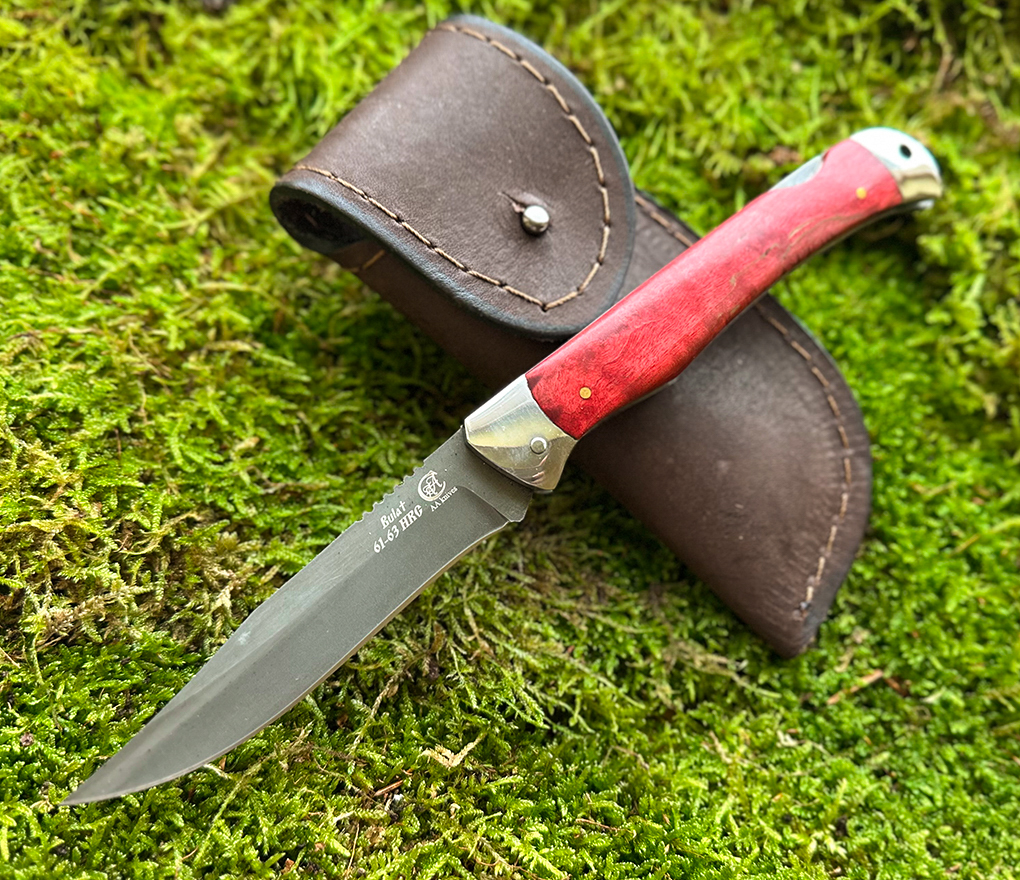
A good example is hand-forged Bulat-Wootz steel, where the multi-layered structure allows combining high hardness with enhanced elasticity — so such an edge withstands stress without losing sharpness. This combination is why artisan craftspeople still prefer forging over simple casting for mass production.
Stainless vs carbon steel
Stainless steel contains chromium, which forms a protective layer against corrosion. It’s convenient in the kitchen or wet environments because it requires less attention. However, it’s usually softer and loses its edge faster under intensive use.
Carbon steel (including alloyed variants with high carbon content) typically allows for higher hardness and a sharper edge, but requires regular maintenance — drying, oiling, storage in dry conditions. Rust appears quickly on such steel if left damp after use.
The choice between the two isn’t about which is “better” in general, but about what work and environment the knife will be used in. A fisherman by the water might prefer stainless to reduce rust concerns, but a hunter prioritizing sharpness in field conditions often chooses carbon steel, accepting the additional maintenance burden.
Edge retention vs sharpening convenience
Higher hardness means the edge stays sharp longer, but it’s also harder to sharpen at home — you’ll need better-quality stones or fixed-angle systems. Softer steel loses its edge faster, but you can restore it in minutes with a simple whetstone.
This is a trade-off that depends on how often you use the knife. If used daily in the kitchen, quick sharpening is a priority. If the knife goes to the forest or hunting for several days, the ability to maintain sharpness without on-site restoration becomes more valuable.
Alloyed steels — a compromise, not a compromise on quality
Modern alloyed steels try to combine several properties at once by adding elements like tungsten, vanadium, or molybdenum. This allows increasing hardness, toughness, and corrosion resistance without sacrificing too much in any direction.
For example, Folding knife hand forged Bulat-Wootz steel uses alloyed Bulat steel with an H12MF and ShH15 metal base, resulting in 62-64 HRC hardness while retaining the elasticity characteristic of forged steel rather than cast steel. Each blade of such steel acquires an individual pattern because the structure forms through a hand-craft process, not a standardized industrial cycle.
How to decide in practice
- Determine the primary use — kitchen, hunting, camping, or collecting demand different priorities.
- Assess how often you’re willing to sharpen the knife and whether you have suitable tools for it.
- Consider the environment — moisture and salt accelerate corrosion in carbon steel more than in stainless steel.
- Don’t rely solely on the HRC number — also ask about toughness and heat treatment quality.
The right steel always depends on context, not the highest number in the spec sheet. Before buying, think about the conditions where you’ll use the knife most often, and only then compare materials. Also remember to check local regulations regarding blade length and carrying, as they differ by country.
Frequently Asked Questions
Does higher HRC hardness always mean a better knife?
No. High hardness provides longer edge retention, but can increase brittleness. The steel's toughness and heat treatment quality matter as much as the number itself.
Why choose carbon steel if it rusts?
Carbon steel often achieves higher hardness and a sharper edge than stainless steel, which matters for hunting or camping knives. Regular maintenance compensates for the rust risk.
What is Bulat-Wootz steel?
It is hand-forged, cast carbon steel with a unique layered structure that provides high hardness combined with enhanced toughness and elasticity. Each blade develops an individual pattern.
How do I choose a knife by steel type if I don't know the exact purpose?
Think about the most common use — kitchen, outdoors, or collecting — and compare how important sharpening convenience is against long-term edge retention.
Folding knife hand forged Bulat-Wootz steel
 No products in the cart.