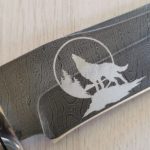
“SKANDINĀVS” Knife Specifications:
Blade material: hand-forged Damascus steel (HVG, U10, ShH15), 800 layers
Blade hardness: 60–62 HRC
Blade length (mm): 136 / 5.35 inches
Blade thickness (mm): 3
Widest point of the blade (mm): 31
Handle material: stabilized Karelian birch
Total length (mm): 265
A high-quality hunting knife that is useful both for the initial processing of game and for later butchering. Its hand-forged blade is made of Damascus steel, which makes it very hard, yet at the same time flexible and durable.
These unique material properties are achieved by creating an alloy of soft and hard metals, resulting in an excellent hunting knife with a well-known pattern; thanks to its micro-serrated blade, it will last a long time and retain its sharpness for a very long time without needing to be sharpened.
The noticeable widening of the blade makes it particularly suitable for gutting game, while the easily controllable tip and the taper at the end of the blade prevent damage to internal organs during evisceration or unnecessary cutting of the meat during subsequent processing.
The handle, on the other hand, is made of wood, which—unlike synthetic materials—feels much more pleasant and comfortable in the hand.
For the hunter’s own safety, a guard is built into the space between the handle and the blade, which prevents accidental injury to the fingers while skinning and processing game, even if the hands become very slippery.
The package also includes a durable, dark-colored leather pouch with a secure snap closure, which will protect the pocket knife from adverse environmental conditions and eliminate any worry about accidentally losing it. The sheath has two loops through which the knife can be attached to a belt, ensuring it is easily accessible at all times. One is a classic fixed loop, while the other is a free-hanging loop that allows the knife to dangle freely yet securely from the belt, facilitating movement and avoiding the discomfort that arises when you have to sit down during a hunt or drive from one hunting stand to another, but the knife is attached to the fixed loop and uncomfortably presses against your leg or waist.
This elegant knife will serve hunters well for a long time thanks to its outstanding features. It is lightweight and fits comfortably in the hand, allowing you to process game quickly, safely, effectively, and with high quality.
Damascus steel – Forged Damascus steel is created using a stack of steel sheets of varying hardness and strength, which are layered into a plate in a specific sequence. This sheet is then repeatedly forged and bent, forged and twisted, resulting in numerous layers within the steel and a unique pattern on the blade.
This extremely difficult technological process is carried out manually by hand. Knives with Damascus steel blades are characterized by enhanced durability and high hardness; they have excellent cutting properties, are visually stunning, and will remain sharp for a long time.
“AA knives” made of Damascus steel have more than 700 layers.
Damascus steel set: ShH15 + HVG + U10A, 700–1,000 layers, heat-treated at 860°С
Advantages of Damascus steel knives:
Increased durability
High hardness
Excellent cutting performance
Beautiful design
Long-lasting sharpness
Hardness: 60–62 HRC.
Handcrafted
Use and Care of Damascus Steel
Damascus steel is widely recognized as one of the most durable types of knives, making it the choice of hunters, anglers, and outdoor enthusiasts.
The Damascus steel offered by AA Knives is forged from three different types of steel, resulting in a material with a well-known and unique pattern that combines the three positive working properties of the steels used—strength, flexibility, and the ability to retain a sharp edge for a long time. It is believed that, thanks to its outstanding cutting performance, this steel often even outperforms stainless steel products, as its blade creates a micro-serrated surface that is unique to steels forged together. Since Damascus steel is one of the most rust-resistant steels, it is especially important to remember to care for it properly.
Just as you wouldn’t immediately put a hunting rifle you’ve brought home from a hunt—one that hasn’t been wiped down and cleaned—into a safe, you, too, must take care of your knife, which serves a much more important purpose during a hunt than a firearm. After use, a Damascus steel knife must be thoroughly wiped down, cleaned of dirt, and dried so that it does not absorb moisture during storage, which could cause rust over time, and you shouldn’t forget to oil it. You don’t need to buy professional care products for this; any cooking oil found in the kitchen will do, since a hunting knife almost always comes into contact with meat and other food products, so using machine oil to protect the knife is not recommended. Don’t forget about regular sharpening and maintenance, either.
However, we’ve all had moments when we’ve left a knife we’ve just used in the car or at the bottom of a bag, and after it’s been there for a while, dark spots appear on the blade—the first signs of rust. But does that mean you should give up on your favorite tool? Absolutely not! To fix the problem, simply go to any computer store and buy the finest-grit sandpaper (P2000–2500) and gently rub the blade to remove the rust spots.
Keep in mind that a knife will last longer and perform better during use if you take a moment each day to care for it properly, but if you’re still unsure about how to care for your knife after purchasing it, AA Knives will be happy to offer advice to make working with your knife comfortable and enjoyable.