


How to Store Knives Safely to Keep Them Sharp and Secure
A knife lies in the drawer next to forks, spoons, and a tangled phone charger cable. Each time the drawer closes, metal clinks against metal, and the blade edge gradually becomes imperceptibly uneven. After a few months, cutting requires twice as much force, even though the knife looks the same as before.
\n\n
Storage affects the blade as much as cutting technique or sharpening. Many people think sharpness only fades from use, but in reality, much of the damage happens during idle periods between uses.
\n\n
Why the Drawer is the Worst Option
\n
Metal edges rubbing against other objects create microscopic burrs. These aren’t visible to the eye but are noticeable to the touch—the knife starts to \”catch\” where it once glided smoothly. Without a drawer organizer, every search for another utensil risks this same damage. Additionally, there’s injury risk when reaching blindly into a drawer, not seeing which way the blade is pointing.
\n\n
Drawer Organizer as a Compromise
\n
If a drawer is your only option, a wooden or plastic organizer with individual slots for each knife is far better than loose storage. The blade doesn’t contact other metal objects, and the handle is always on the same side—this speeds up safe removal without fumbling in the dark.
\n\n
Magnetic Strip – Convenient but with Considerations
\n
A magnetic strip on the wall saves space and lets you see all your knives at once. It’s a good choice for a kitchen where knives are used daily. However, a few things must be observed: insert and remove the knife at a right angle, never slide it along the magnet—otherwise the blade edge contacts the metal unnecessarily often. The strip should be positioned where a child cannot reach it or pull up a chair—the height convenient for an adult is often exactly at eye level for a school-age child.
\n\n
Wooden Block – Classic with Its Own Requirements
\n
A wooden block protects the blade better than most other solutions because the knife stays in a fixed position and doesn’t contact anything else. It’s important to place the knife back in the same slot it came from—different slot sizes may not suit a wider or longer blade and create pressure on the cutting edge. Keep the block away from stove heat and water splashes, as moist wood warps over time, making slots become narrower or wider than originally.
\n\n
Sheath – Essential in Field Conditions
\n
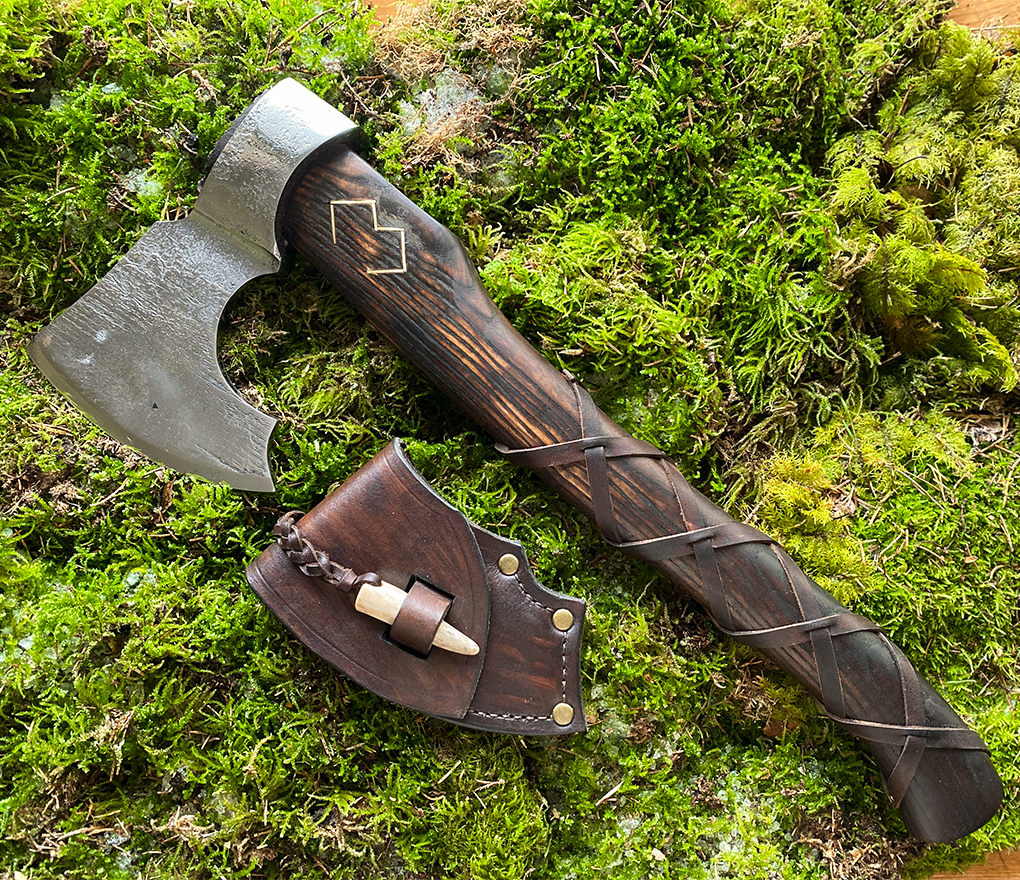
In outdoor conditions, hunting, or hiking, a sheath isn’t a luxury—it’s a necessity. Larger tools, such as HISTORICAL LATVIAN AX – Very good Forged Carbon Steel 9HS, come with a leather sheath precisely because carrying without protection is dangerous for both the blade and the person carrying it. A leather sheath protects the cutting edge from contact with rocks, metal buckles in a backpack, or other tools in a bag. Before inserting into the sheath, the blade must be dry—moisture trapped in the closed space between leather and steel promotes rust formation, especially on carbon steel, which is more susceptible to corrosion than stainless alloys.
\n\n
Safety When Children Are in the Home
\n
- \n
- Choose a storage location the knife cannot be reached by standing on the floor or reaching on tiptoes.
- A block or sheath is safer than loose storage in a drawer because the blade is completely covered.
- Mount the magnetic strip high and not near the kitchen table edge where a child might notice and imitate it.
- Put larger outdoor knives and axes in their sheaths immediately after use, not left on a table or ground \”for a moment.\”
- Regularly check that the sheath fastening (button, strap) still works—a worn closure can open from its own weight.
\n
\n
\n
\n
\n
\n\n
How to Choose Between Options
\n
In a kitchen where knives are used daily, a magnetic strip or wooden block are most practical—they allow quick access and let you see which knife is where. For less frequently used specialized knives, collection pieces, or outdoor tools, a sheath or hard case is better, as they provide complete protection during extended storage. A mixed solution—everyday knives on a strip, others in a drawer organizer or sheath—is often the most practical approach for a typical household.
\n\n
Regardless of which storage method you choose, the blade must be clean and dry before storage. Moisture and debris remaining on the steel cause damage faster than any incorrect storage method. Always check local regulations regarding knife and axe transport and storage in public places, as these vary by country and municipality.
Frequently Asked Questions
Can I store a knife in a drawer with other kitchen tools?
Yes, but only with a separate organizer or cover. Loose storage among other metal objects quickly damages the cutting edge and increases injury risk when reaching into the drawer.
Does a magnetic strip damage the blade?
The strip itself doesn't, if you insert and remove the knife at a right angle. Sliding the blade along the magnet causes the edge to contact the metal excessively, which can create fine damage over time.
How do I safely store a larger outdoor tool, like an axe?
Always use a leather or hard sheath, with the blade dry before insertion. This protects both the cutting edge and anyone transporting the tool in a bag or backpack.
How do I prevent rust during storage?
Always wipe the knife dry before placing it in a block, on a strip, or in a sheath. This is especially important for carbon steel, which is more sensitive to moisture than stainless alloys.
What's the safest storage method at home with small children?
A wooden block or sheath is safer than an open drawer or low-mounted magnetic strip because the blade is completely covered and harder for children to reach.
HISTORICAL LATVIAN AX – Very good Forged Carbon Steel 9HS
 No products in the cart.
