


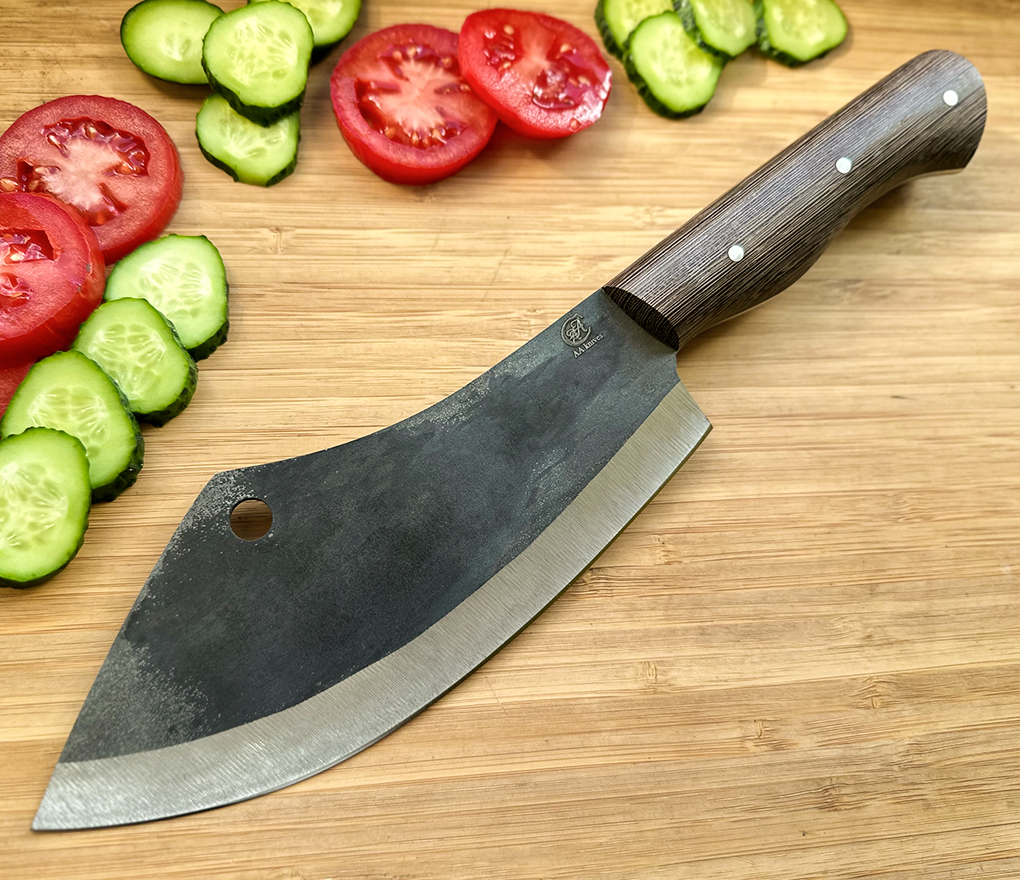
The Cleaver Knife Is Not Just a Bigger Kitchen Knife
A large piece of meat lies on a cutting board, and someone picks up a heavy cleaver-type knife with the intention of cutting through it in one blow. The blade hits the bone, the hand slips, and the knife glances off to the side. Then comes the conclusion that “this knife is no good”—when in fact it was the technique, not the tool, that was at fault.
The cleaver-type knife, often called a cleaver, is one of the most misunderstood kitchen and field tools. It looks like a crude tool for brute force, but in reality it requires a more precise approach than an ordinary kitchen knife. Let us examine the most common mistakes.
Mistake: Thinking Weight Replaces Sharpness
Many buy a cleaver because it looks impressive and heavy, and assume the weight will do the work by itself. In fact, weight helps the strike, but without a sharp edge even the heaviest knife will bounce off a bone or crush meat rather than cut it cleanly. The edge should be sharpened as regularly as any other kitchen knife, especially if used for cutting bones and cartilage.
What to Do Instead
- Check the edge before each major use, not just when it no longer cuts cleanly.
- Use a sharpening angle that matches the edge thickness—a thicker edge requires a slightly wider angle than a thin fillet knife.
- Don’t sharpen in a hurry with the first available stone—rough sharpening damages the edge faster than it is restored.
Mistake: Cutting Bone Like Meat
A cleaver with a wide and heavy edge, such as the SERBIAN KNIFE with its 77 mm wide and 4 mm thick edge, is designed to withstand strikes, but that does not mean you should strike with full force every time. An incorrect strike angle against bone causes notches in the edge that are then difficult to repair without significant metal removal.
A better approach is to hit the joint of the bone or a thinner area rather than trying to cut through the thickest part in one blow. The cutting board also plays a role—hard plastic or glass accelerates edge wear, while a thick wooden board absorbs some of the strike energy.
Mistake: Caring for All Blades the Same Way
Many think all edges can be maintained the same way—rinse, wipe, put back in the block. Stainless steel, such as N695 used in this cleaver edge, is indeed more resistant to corrosion than many carbon steels, but that does not mean complete immunity. A moist environment, a juicy product left on the edge, or prolonged storage in a damp sheath can cause spotting even on quality stainless steel.
Practical Steps for Proper Care
- Immediately after use, wash and dry the edge thoroughly—do not leave it soaking in the sink.
- If the knife is stored in a leather sheath, make sure the edge is completely dry before inserting it.
- Regularly check the handle fastening—the heavy Micarta handle construction is durable, but screws or rivets can loosen slightly over time.
Mistake: Choosing Based on Appearance Rather than Application
Cleaver-type knives are often bought as a collection piece or impressive kitchen accessory, but their true value is revealed when used as intended. If the primary goal is heavy meat and bone work, look at edge thickness, overall length, and handle ergonomics rather than just visual appeal. SERBIAN KNIFE – Cleaver – high quality hand forged stainless steel is a good example of how edge shape and weight are tailored to a specific function rather than just appearance.
Before purchasing, ask yourself—do I really need this knife for heavy striking tasks, or would a lighter kitchen knife and a separate hatchet for wood or game suffice?
Mistake: Forgetting the Legal Side
Large impressive-looking blades sometimes attract attention in places where carrying or using them is restricted. Regulations on blade length and carrying in public places vary by country, so before purchasing and before taking the knife outside your home, check your local regulations.
Summary
A heavy cleaver-type knife is an excellent tool if you understand its limitations and requirements. It is not a universal solution for all cutting tasks, and it does not forgive careless technique or neglectful care. Proper sharpening, mindful strike control, and regular maintenance allow such a knife to serve well for years rather than disappoint after a few weeks.
Frequently Asked Questions
Can a cleaver-type knife be used for cutting bones?
Yes, it is one of the primary uses, but it is better to aim at joints or thinner areas rather than strike with full force at the thickest part of the bone to avoid damaging the edge.
How often should a heavy kitchen knife be sharpened?
The frequency depends on the intensity of use, but the edge should be checked before each major use and sharpened as soon as you notice it no longer cuts cleanly.
Does stainless steel mean the knife does not need to be dried after washing?
No, stainless steel reduces the risk of corrosion but does not make the knife immune to it. The edge should always be wiped dry after washing.
Is carrying this type of knife in public allowed?
It varies by country, so always check your local regulations before carrying the knife outside your home.
SERBIAN KNIFE – Cleaver – high quality hand forged stainless steel
 No products in the cart.
